
GALAPAGOS CRUISE ITINERARY
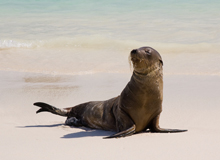
DAY 1 – Baltra Island | Bachas Beach (wet landing)
Start of Itinerary A for 8 Days and start of Itinerary C for 5 days
Fly from the Ecuadorian mainland to the islands on an early morning 90-minute flight. As you prepare to land in Baltra, look out the window. The landscape below will seem otherworldly – you’ll truly be landing in a place like no other. The Galapagos Islands are completely unique and you’re about to see why. Your bilingual naturalist guide will greet you at the airport and meet you after customs. During lunch he/she will introduce you to the islands, specifically the flora and fauna that you will encounter at our first destination, Las Bachas Beach.
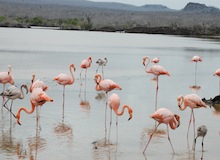
On the sandy white beaches of Las Bachas you will get a close look at a sea turtle nesting area as well as a lake frequented by pink flamingos and other migratory birds. Afterwards, you’ll cool off with a dip in the beautiful, blue Pacific Ocean. As this is the first evening together, the crew will invite everyone to a pre-dinner cocktail on the yacht before the welcome dinner. If the night is clear, as it usually is, the stars above will sparkle; look for the Southern Cross, the Big Dipper (turned up-side down!) and Orion.
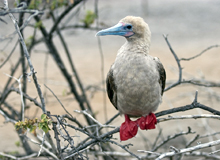
DAY 2 – Genovesa Island: Darwin Bay (wet landing) | El Barranco (dry landing)
Early in the morning you’ll have breakfast and then you’ll disembark at Genovesa “Tower” Island, which is located in the northeastern part of the Galapagos (less than half a degree north of the equator). At “Tower” Island you’ll anchor at Darwin Bay, which is located on the southern part of the island, and is actually the caldera of an extinct, partially eroded volcano, with the surrounding cliffs forming the inner lining of the rim. While the origin of the name “Tower” is not known, one can imagine it had something to do with these towering cliffs. The tour will be a long, fairly-easy walk, but it is usually hot and dry here, so you may want to carry some water. After a wet landing on a coral beach the trail begins in an area where there are several swallow-tailed gulls. As you walk back from the beach, you’ll see a variety of Opuntia cactus and mangroves.
Tower is an outpost for many sea birds (as Española is in the south). Interestingly, there are almost no land reptiles on Tower, only very small marine iguanas. This is attributed to the direction of the ocean currents, which wouldn’t have carried the terrestrial animals here.
Visit El Barranco during the afternoon then return to the boat for dinner.
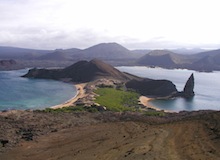
DAY 3 – Bartolome | Sullivan Bay
Bartolome Island, which at its highest point is 114 meters, is one of the most photographed vistas in the archipelago. This island is quite young and quite volcanic, therefore, it’s relatively unpopulated; only a small handful of die-hard plant and animal species have survived long enough to call this lava-land home.
After the visit to Bartolome Island you’ll visit nearby Sullivan Bay. At the turn of the century a huge lava flow spilled right down to the sea and today you can stroll across this black volcanic expanse, admiring its time-frozen ripples, bubbles and ropes.
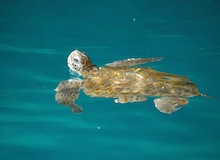
DAY 4 – Black Turtle Cove | Cerro Dragon
Black Turtle Cove, is a red mangrove lagoon on Santa Cruz and is a nursery for many sharks and rays. It’s also a great location to observe mating turtles around this time of year. You might see a large groups of resting White-Tip Reef Sharks, schools of Golden Rays and Spotted Eagle Rays, and a few juvenile Scalloped Hammerhead Sharks and Black-Tip Sharks. The water very calm so we often used paddles instead of the loud panga engines to move around the area.
After this visit you’ll navigate for a couple of hours to Cerro Dragon, where you’ll make a dry landing on lava rocks. Cerro Dragon is a small bay on the west coast of Santa Cruz and got its name from the many land iguanas that live in the area. Land iguanas are endemic to the Galapagos Islands where they have found good mating and nesting areas.
DAY 5 – Santa Cruz Island (dry landing)
End of itinerary C for 5 Days and start of Itinerary D for 4 days
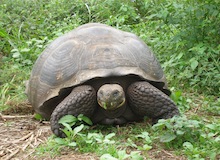
Charles Darwin Station. After breakfast you’ll sail to Santa Cruz Island, where you’ll visit the world-famous Charles Darwin Station, a non-profit institution that dedicates itself to studying and protecting the flora and fauna of the Galapagos. This is one of the best places to see land tortoises, including Lonesome George museum.
Then you’ll visit the station’s Tortoise Rearing Center. Here you can find baby, hand-sized tortoises, between the ages of one and five, and marvel at how they achieve such large sizes as adults (500 lbs. or more!). Galapagos tortoises are believed to have a lifespan of over 100 years, so the young ones have a long life ahead of them as long as they receive the protection they need.
Aside from the Station headquarters, Santa Cruz Island is home to the largest town and economic center of the Galapagos, Puerto Ayora. In this portside town you can buy souvenirs (postcards, t-shirts, books, etc.) of the islands. Check out the unique Galapagos ceramic shop near the entrance of the Charles Darwin Station. After shopping in Puerto Ayora and lunch on the boat (guests may dine in town if they desire), you’ll explore the highlands or “parte alta” of the island, which is a moisture-rich area with fertile volcanic soils. You’ll learn about the vegetation and animal life of this zone, often strikingly different than that found at lower elevations and our best opportunity to find the famous giant tortoises in their natural habitat. Darwin’s Finches, Yellow Warblers, and other land birds will fly in and out of the moss-covered trees. From this high vantage point you’ll be treated to beautiful views of the island.
In the late afternoon you’ll return to town. For those who wish to check out the nightlife, this is your chance; the boat will be docked in port most of the night.
DAY 6 – Floreana Island: Cormorant Point (wet landing), Corona del Diablo (wet landing), and Post office bay (wet landing)
When you wake up and look out your porthole on Day 6 you will see Floreana, one of the greenest islands in the archipelago. Ask your guide to tell you about its mysterious history laden with rumors a murderous baronesses, blackmail, and dubious disappearances.
Your first stop is Post Office Bay, where the islands’ original post office (really only a wooden barrel) was established in 1793. The current system still functions as it did three centuries ago: Visitors drop off unstamped letters and postcards AND pick-up whatever mail they can hand deliver themselves when they return home! (Try it, it actually works!).
Back on the yacht and after lunch you’ll skirt the island’s coast until you arrive at La Corona del Diablo (the Devil’s Crown), an old volcanic crater that offers some of the most spectacular snorkeling in the Galapagos. This is a great spot for seeing the wide array of tropical fish, many endemic to the islands, including purple sea stars and spiky sea urchins. The crater’s most thrilling undersea creatures, however, are the white-tipped sharks. As with most of the creatures in the Galapagos they are unperturbed by your presence, so you can swim in their company freely and fearlessly.
After returning to the boat you will visit Punta Cormorant, where you’ll follow a footpath to a lagoon inhabited by flaming-pink flamingos. You will also pass by a white sand beach, a Sea Turtle nesting area and a great spot for watching sea birds and sea rays.